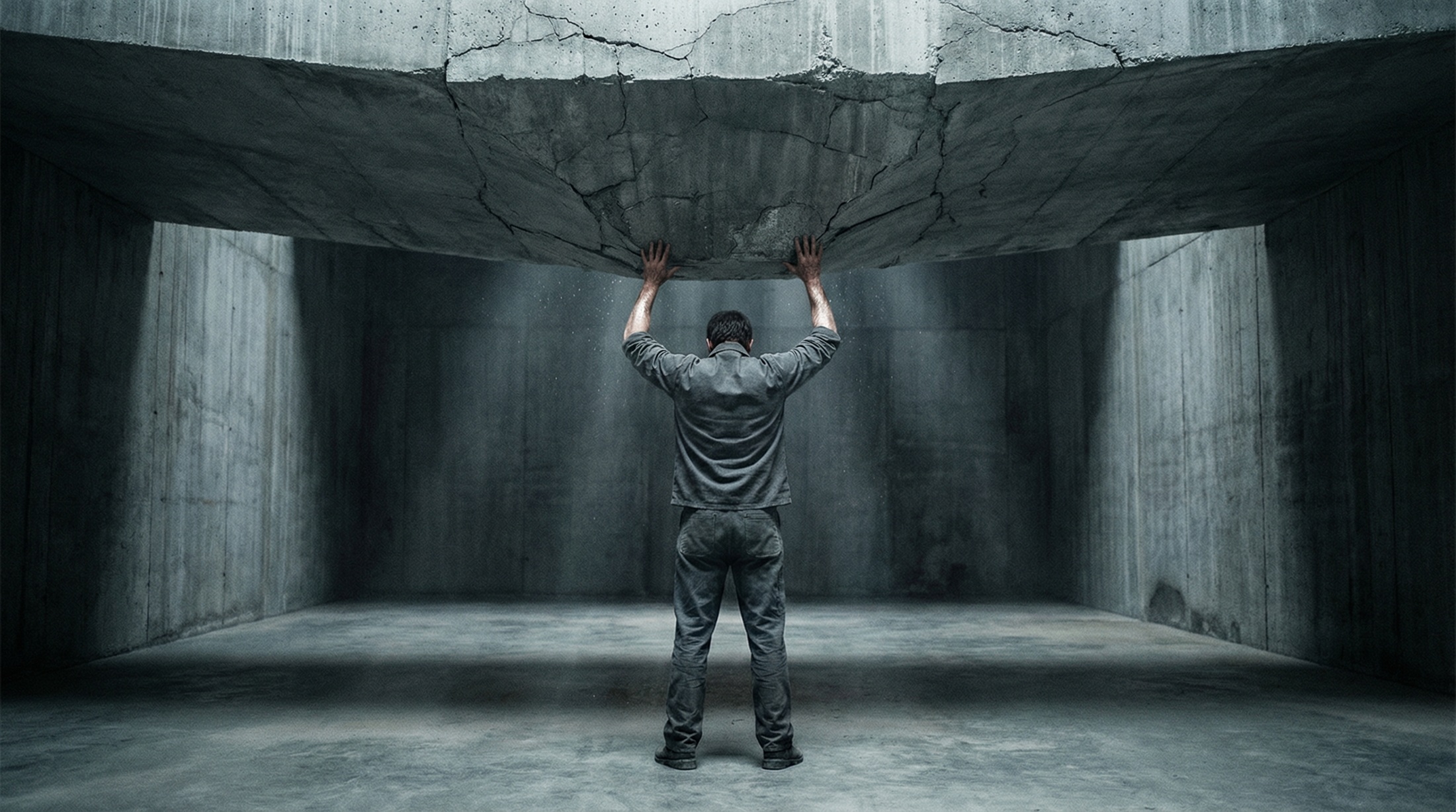
Every human being produced by civilized society carries a burden shaped for them before they were old enough to refuse it. The machinery of culture does not ask permission. It designates which pain is speakable and which must be absorbed privately, and which suffering earns acknowledgment versus which is expected to disappear into function. These assignments are not random. They follow the lines of gender with a consistency that reveals design, not accident.
Some burdens are visible, documented, examined, named in public language. Others are quietly held, carried inward, converted into something more acceptable to the people who benefit from the carrying. Neither is lesser or cancels the other. The weight of one person's assigned burden does not diminish the weight of another's.
Suffering is not a competition; it is a distribution.
What men carry is largely invisible, though not because it is smaller; they were trained from the beginning to make it so. The silence most men inhabit is neither a personal failing nor natural; it was constructed, installed early, and reinforced until the man himself can no longer locate the seam between who he is and what he was told to become.
The construction deserves examination: what it was built from, and what it costs. Naming it is the only place the work can begin.
The Silence Was Installed
A boy does not arrive in the world already knowing that his pain is less important than his performance. That lesson is taught.
It arrives through correction, in the posture of fathers who converted their own buried grief into standards of toughness, in coaching culture that rewards stoicism and redirects tenderness. The specific withdrawal of approval that follows a boy who shows too much or stays too long inside his feelings completes the instruction. Show less, need less, manage the rest privately where it will not become anyone else's inconvenience. The message is never delivered cleanly in a single conversation. It accumulates through hundreds of small adjustments until the boy understands the contract without having read it.
By the time a man is grown, the silence is no longer external. It has been fully absorbed. It lives in him not as instruction but as instinct. He does not decide to be quiet about what he carries. He simply is. The original lesson has become invisible to him, which is precisely how assigned behavior becomes what people call nature.
This distinction matters more than it appears to. What was constructed can be examined. What passes as nature cannot. Calling a man's silence strength closes the question before it is asked. The question deserves to be asked.
The Architecture of Usefulness
A load-bearing wall holds everything above it without acknowledgment. Its value is assumed. Its condition is checked only when something threatens to fail. Nobody asks what it costs the foundation to hold the ceiling through every season. That question is not considered relevant, because the wall is not a person; it is a function.
This is the position men are assigned inside the systems they inhabit, their value understood as structural. A man who performs his functions without visible strain is considered normal. A man who performs them while visibly struggling is considered a liability. The one who stops performing them altogether becomes a problem to be managed or a resource to be replaced. What accumulates inside him, what it costs to hold what he holds, registers nowhere in that accounting.
Consider what this means in practice. In work, a man can be discarded when a cheaper version of his output becomes available. His years, his accumulated investment in the institution: these are not moral claims the institution feels obligated to honor. In relationships built around what he provides rather than who he is, the room grows colder when he stops delivering. With the quiet efficiency of a system recalibrating around an absent resource.
Society does not hate men. It simply proceeds as though they will endure whatever is required and replaces them efficiently when they cannot. That is more impersonal than hatred, which makes it harder to name and harder to argue against. Cruelty can be confronted. Impersonal efficiency cannot. The machine does not mourn the part it replaces. It recalibrates and continues.
What this produces in a man is a specific, quiet vigilance. He learns without ever having language for it that his continued acceptance is conditional and output-dependent. He stays useful and stops asking whether being useful is the same as being valued, because the gap between those two things, once fully named, has nowhere productive to go.
Needed Is Not the Same as Known
A hammer is needed but not known.
A man relied upon as a provider, a protector, occupies a role that is intimate in proximity and impersonal in nature. The people in his life require his function. They do not always require his interior life. They want the product of his endurance, not the account of what producing it cost him.
This is the architecture of isolation that looks, from the outside, like strength.
When a man is in pain, he is rarely met with the same open reception that greets visible suffering. He is met with a calibration: is this going to resolve quickly, or is this going to be a disruption? Public fracture invites correction before comfort. He is reminded, directly or through the room's adjustment around him, that the structure is supposed to hold. So he learns to fracture privately. In parked cars. In the early hours when the house is quiet. He holds humor just a half-step too tight, or disappears into work with an urgency that has nothing to do with ambition.
He does not stop needing. He stops asking. The particular injury in this is that it does not feel like suppression to him. It feels like maturity: he has been taught that managing his interior life is the adult thing, that asking for the room to hold him is the imposition rather than the silence. He carries the silence as a virtue, which is the most complete form of the installation. The man who is proud of his silence cannot examine it.
The Measurement Problem
A man is measured by his outcomes rather than his effort, his intention, or what the production cost him.
The praise he receives is for output: the thing delivered, the problem solved. The sacrifice absorbed without visible damage earns no separate entry in the accounting. His interior life does not appear on any ledger anyone consults; it is not part of the calculation.
What this builds over years is a man who is expert at performance and a stranger to his own interiority. He knows how to deliver. He does not know how to locate what delivery is costing him, because that accounting was never modeled for him. What was modeled was endurance; what was applauded was output. The distance between what he produces and what he experiences was not a space he was taught to inhabit.
That distance widens without announcement. A man in his twenties who swallows fear to appear capable becomes a man in his forties who genuinely cannot find the fear anymore. He did not heal. He simply lost the map to it. The appropriate internal report is not fine; it is that he has stopped checking.
When he eventually collapses, the analysis is brief and brutal. He should have been stronger. Asking for help sooner gets added to the verdict, as though asking were a natural reflex for someone trained from the beginning that asking is a weakness the room cannot afford.
Where the Pressure Goes
Pressure does not disappear. It converts.
A man who cannot name his grief will release it through a different exit. He converts it into humor that lands slightly too dark, into rage that arrives at the wrong address. The last conversion is a numbness so complete that he is technically present and functionally unreachable. These are not character failures. They are the predictable output of a system that blocked every other door.
The people close to him often recognize the symptoms without understanding the cause. They say he is distant and never talks about anything real. What they are observing is managed overflow from a system at capacity. The too-dark humor is grief in a mask that received the invitation. The misplaced rage is fear with no legitimate exit. What reads as indifference is the last available form of self-protection in a man who was never given permission to use any of the earlier ones.
He did not choose these exits. They were the only ones left open.
The Documentation Problem
This is not an argument about whose suffering is greater; that calculation is both unanswerable and beside the point.
The point is documentation. One wound gets named, studied, placed in the record. Language and institutions get built around it. The other gets absorbed, converted, and disappeared. The man carries it alone because somewhere early, without his input, his interior suffering was designated a private inconvenience rather than a shared concern worth examining.
Both wounds are real. Both are heavy. Systems extract endurance from both without investing in the people doing the enduring.
What breaks a man is not the weight but carrying it inside a structure that insists the weight is not real, that mistakes his compliance for consent. His silence gets named as strength rather than as a wound that was never allowed to close.
He was handed a contract he never signed: produce and endure, keep the cost invisible. The room requires him to hold it; it does not hold him in return. It was placed in his hands early enough that he forgot it was placed there at all.
A man who cannot put the weight down and examine it cannot choose it. He can only repeat it. What is repeated without examination is not strength; it is inheritance.
Name it. That is where the work begins.