The Patterns
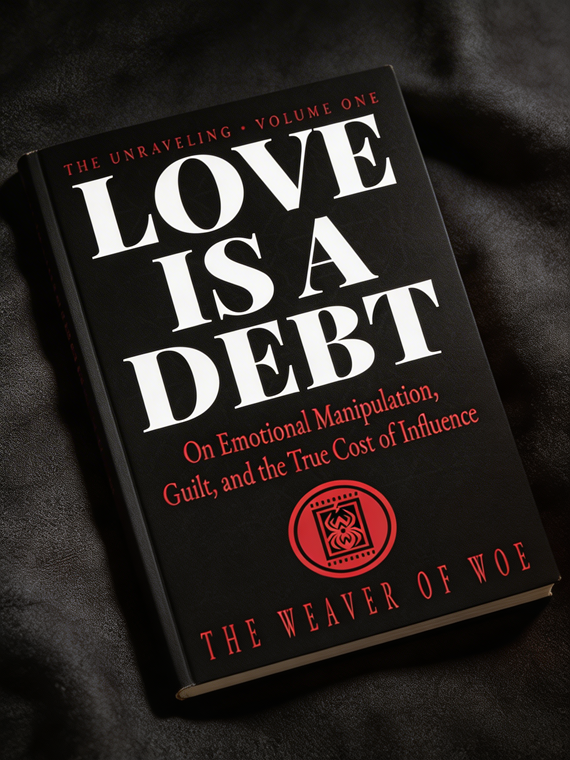
Love
Is a
Debt
On Emotional Manipulation, Guilt, and the True Cost of Influence
Love is not a feeling. It is a footprint.
Most people cannot tell the difference between guilt and consequence. One belongs to you. The other was handed to you by someone who learned your decency is a lever that works.
Love Is A Debt is not a book about healing. It is a book about precision: the surgical ability to distinguish between what you genuinely owe the people you have matured to, and what has been fraudulently charged to your conscience by people who profit from your confusion.
“Need admits its hunger. Leverage assigns you the job of feeding it. That distinction is the cleanest blade you will ever hold.”
This is philosophy in the tradition of the surgical and the severe. Not self-help. Not comfort. The Weaver does not meet you where you are. He names where you have been standing and what it has cost you to stay there.
Through eleven chapters and their accompanying parables, each a narrative rendering of the mechanism under examination, Love Is A Debt dismantles the four forgeries of love, then builds the case for what genuine obligation actually requires: access held with care, ambiguity named before it compounds, restraint when leverage was available, repair when harm is real, and a clean ending when presence becomes dishonesty.
Prologue
The Bill You Do Not See
The debt begins the moment you become significant. Love is not a feeling. It is a footprint.
Chapter One
The Ledger
Love rots through accounting. The moment warmth becomes evidence, intimacy becomes surveillance.
Chapter Two
Collateral
How need becomes leverage. How vulnerability becomes a blade turned sideways so it looks like a wound.
Chapter Three
Debt Maintenance
Grand gestures are not repair. They are maintenance. The minimum payment required to keep the debt alive.
Chapter Four
Imbalance
How generosity becomes entitlement. How one person’s extraordinary becomes another person’s ordinary.
Interlude
The Hinge
The fraud has been named. The temptation is to conclude that all debt is false. That conclusion is only recoil.
Chapter Five
Love Is Power
To be loved is to be entrusted with keys. Power without responsibility is violence in slow motion.
Chapter Six
The Sacred Place
Intimacy is access. Access is a moral burden. The sacred place is not yours because someone unlocked it.
Chapter Seven
Clarity
Ambiguity is unpaid true debt. Fog is not kindness in waiting. It is harm on a schedule you set alone.
Chapter Eight
Restraint
Love is paid in what you refuse to take. The blade you held and did not swing. The leverage left on the table.
Chapter Nine
Repair
Regret is weather inside you. Repair is weather inside them. One costs you comfort. The other costs you the need to be comforted.
Chapter Ten
The Clean Ending
A dull blade hurts longer than a sharp one. The third payment of the true debt. Departure with dignity.
Chapter Eleven
Refusal
Some debts should never be repaid. Leaving a trap is not betrayal. It is the first honest act in a room built on fog.
Epilogue
The Final Standard
Love is a debt. Not to a person’s claim. To what you changed. Now you know how to pay it.
“You are not charged for intention. You are charged for consequence.”
Each chapter pairs philosophical argument with a parable. The ledger kept in a Notes app. The panic attack that arrives on schedule whenever you try to leave. The necklace delivered on the anniversary of the same wound. The Google Doc itinerary for a trip that was never going to happen.
These are not cautionary tales. They are forensic evidence. The Weaver does not offer them as comfort. He offers them as recognition: the specific, vertiginous feeling of seeing something named that you have lived but never had words for.
“If love requires accounting, it was never affection. If love requires leverage, it was never safe. The purest proof is harm you chose not to do.”
“The debt is not a chain to them. It is a vow to reality.”
“Need admits its hunger. Leverage assigns you the job of feeling it.”
Love Is A Debt will not tell you that you are enough. It will not hold your hand through the argument or soften the conclusions because they are uncomfortable. It will tell you, with precision and without apology, what you actually owe, and what you have been paying that was never yours to pay.
The difference will cost you something.
So will staying confused.
This is Volume One of The Unraveling.
The series has only begun.
Published by Mordant Press