Sigmund Freud argued that the father must be a threat. That without the fear of the father, the son never fully separates from the comfort of the mother, never individuates, and never becomes a man. The claim became a cornerstone of psychoanalytic theory and filtered, over decades, into the broader cultural assumption that hardness in a father is not merely acceptable but necessary. That the edge in him is the point.
Freud was not entirely wrong; he was precisely wrong, which is more dangerous than being obviously wrong.
The observation buried inside the claim is real: a boy requires resistance. He requires something in his environment that does not yield to him, does not reorganize itself around his comfort. His tears are not currency here, and his charm finds no negotiating leverage. Without that resistance, he never develops the capacity to locate himself. He remains a soft thing pressed against soft things, with no edges to define him.
Resistance, however, is not the same thing as threat.
The claim collapses precisely where it conflates these two things. It sees the instrument and mistakes it for the process. It also does something more insidious than get the mechanism wrong: a controlling man is handed permission to call his ego law. The language of necessity gets provided for what is, in practice, the exercise of unexamined personal damage on a child who cannot yet defend himself against it.
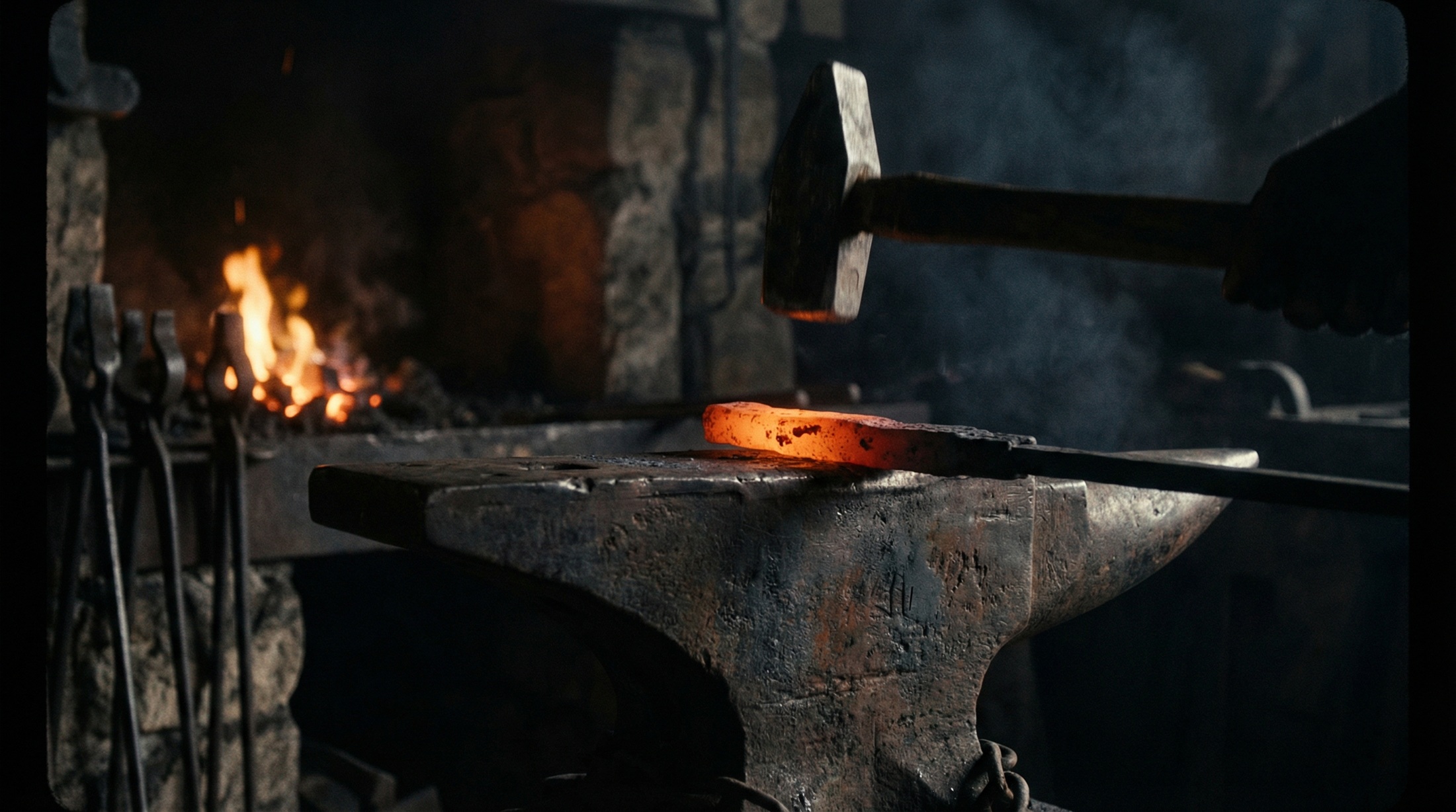
The hammer is not the point; what it produces is, and that depends entirely on how it is used.
What Threat Builds
A boy raised under threat learns the oldest survival skill available to the small and powerless: he learns to read the room.
He learns timing, and which version of himself produces the least friction in the presence of the threat. He becomes fluent in performing that version on demand. The real thing gets kept somewhere the threat cannot reach it, with the performance sent out to handle the danger. He becomes, over time, an expert at surviving inside a room.
He is a beginner at surviving inside himself.
This is the specific damage that threat produces. The boy builds compliance architecture: a structure designed entirely to satisfy the threat rather than to sustain the person. It holds as long as someone is watching. When the room empties, it collapses, because it was never load-bearing; it was decorative.
When the threat eventually leaves his life, the structure it built leaves with it. The man finds himself without interior scaffolding. He has learned timing and concealment, appeasement and performance, but not how to govern himself when nobody is watching, which is the only governance that counts for anything. The raw material for that capacity was never provided. He was shaped by the presence of fear rather than forged through contact with a standard, and the difference between those two things is not subtle.
Fear as a shaping tool produces reactivity. The boy shaped by fear becomes a man who manages his environment rather than himself. He is very good at reading rooms and a stranger to his own interior. In the presence of an audience the performance holds; in private, where no audience exists to perform for, it dissolves.
A threatened boy does not become a man. He becomes a skilled performer in a man's shape.
The Two Cowardices
A father who is only a threat is a coward who wants obedience. A father who is only a friend is a coward who wants applause.
These are not opposites; they are the same negotiation conducted from different positions. Both fathers placed their own need at the center of the arrangement and dressed it in the language of parenting. One calls his insecurity discipline; the other calls it warmth. Neither is raising the boy. Both are using him to manage something unresolved in themselves.
The friend-father deserves examination because his failure is the less visible one. He is present, engaged, accessible, and knows his son's friends, his son's grievances. He has elected to be the approachable one, and he has built a philosophy around that preference. What he has actually elected is his own comfort. Being liked matters more to him than being steady, and the son pays the price for that preference with his formation.
The boy grows up with a companion where he needed a standard. When the world eventually refuses to companion him, when it delivers consequences without waiting for his emotional readiness, he has no interior model for meeting that refusal. The world will decline to reorganize itself around his feelings, and nothing in his formation prepared him for that. The friend-father gave him proximity without instruction. He gave him everything except the one thing the world will require of him without negotiation: the capacity to function without approval.
Both failures are negotiations with ego dressed as parenting philosophy. The work of a father requires him to subordinate what he wants from the relationship to what the son needs from it. That is the harder thing, and also the only thing that produces a result worth producing.
Gravity Does Not Negotiate
Steel is not made strong by a man swinging at it in anger. Too much heat and it becomes brittle; too little and it never changes form. The hammer matters, the temperature matters, and timing matters too. What does not matter, even slightly, is whether the steel is afraid of the hammer. Fear has nothing to do with the metallurgy. It never did.
The Law of the Father operates the same way.
It is gravity, not intimidation: the steady refusal to bend reality so the child can keep believing in his own comfort. Real authority holds its temperature regardless of whether the boy finds the heat pleasant. It does not need to announce itself or require the boy's agreement to remain what it is.
A raised voice is not authority. Domination is not law. What the theater of anger staged for an audience of one frightened child produces is not a consequence worth the name. These are insecurity wearing the costume of strength, and most boys, who are more perceptive than they are given credit for, know the difference immediately. They know it because real authority does not need to perform itself. It simply is what it is, and reality responds to it accordingly.
A father who must make himself feared to be respected has already lost the argument. He has demonstrated that his standard cannot hold without enforcement. The boy reads this accurately: the standard is not about his formation but about the father's control. He will learn to appear compliant and nothing more than that appearance.
The Mirror That Does Not Soften
Real authority is what happens when love stops functioning as a shelter and starts functioning as a mirror.
The mirror is not flattering. It holds the image steady and does not flinch from it, does not weaponize disappointment, and does not require the boy's agreement to continue holding what it shows. Consequences exist because reality contains them, not because the father invented them to demonstrate control. The verdict is simple and does not change: you are not entitled to softness, only to the results of your choices.
This requires something from a father that is rarer than anger. It requires the willingness to be disliked.
The target is not fear but something more precise: being disliked. The difference is precise. Fear produces the performer. Being disliked, when the standard holds regardless, produces something different: a boy who pushes against something real and finds it does not move. Who accumulates, through repeated contact with that immovable thing, a felt understanding that reality contains consequences which exist independently of his feelings about them, and who discovers that something in his world cannot be manipulated or charmed into reorganizing itself around his preferences.
That discovery is the gift. The gift is not the warmth or the friendship offered before the formation is complete. The immovable standard. The presence that does not require his love to sustain itself, which means it can hold through every season of the relationship, including the seasons when the boy withdraws his love entirely, which he will do repeatedly as part of the process.
The father who needs the son's love to hold his own position cannot hold the standard when that love is withdrawn. The one whose standard stands independent of the son's approval can hold it through every withdrawal. He can be disliked today so the son is not devoured tomorrow.
The Interior Father
The friendship comes later, arriving not as a reward for the son's demonstrated strength but as a natural endpoint of the formation.
When the son no longer needs the father to regulate his impulses. When he has built the standard inside his own chest and carries it into every room he enters, including every room the father will never see. He governs himself in private. The question has shifted from whether anyone is watching to whether he can stand behind his own choices when no one is.
That interior father is the actual product of the work. The voice the son eventually carries that is no longer the father's voice but his own: the accumulated weight of every consequence that was not softened, every standard that held when it was unpopular. Every moment of discomfort that was rescued too early left a gap where a lesson was supposed to land.
A threat cannot build that. The man it produces needs the threat present to behave. A standard builds it. So does gravity, and a temperature that holds without ego, without requiring fear to function.
The measure of the work is not obedience; it is what the son does alone, in the dark, in a room his father has never entered, when no one is watching and nothing enforces the choice except the standard he built inside himself.
That is formation. Everything else is performance management.
The distinction between a father who was a threat and a father who was a standard only becomes fully visible from a distance. The threatened boy knows it in his twenties, when the compliance architecture collapses because no one is left to enforce it. Decades later, the formed man finds his standard still standing in rooms his father never entered.
One inheritance is a cage that requires a keeper. The other is a compass that functions in the dark.
A law that requires fear to function was never law. It was control wearing the face of care.