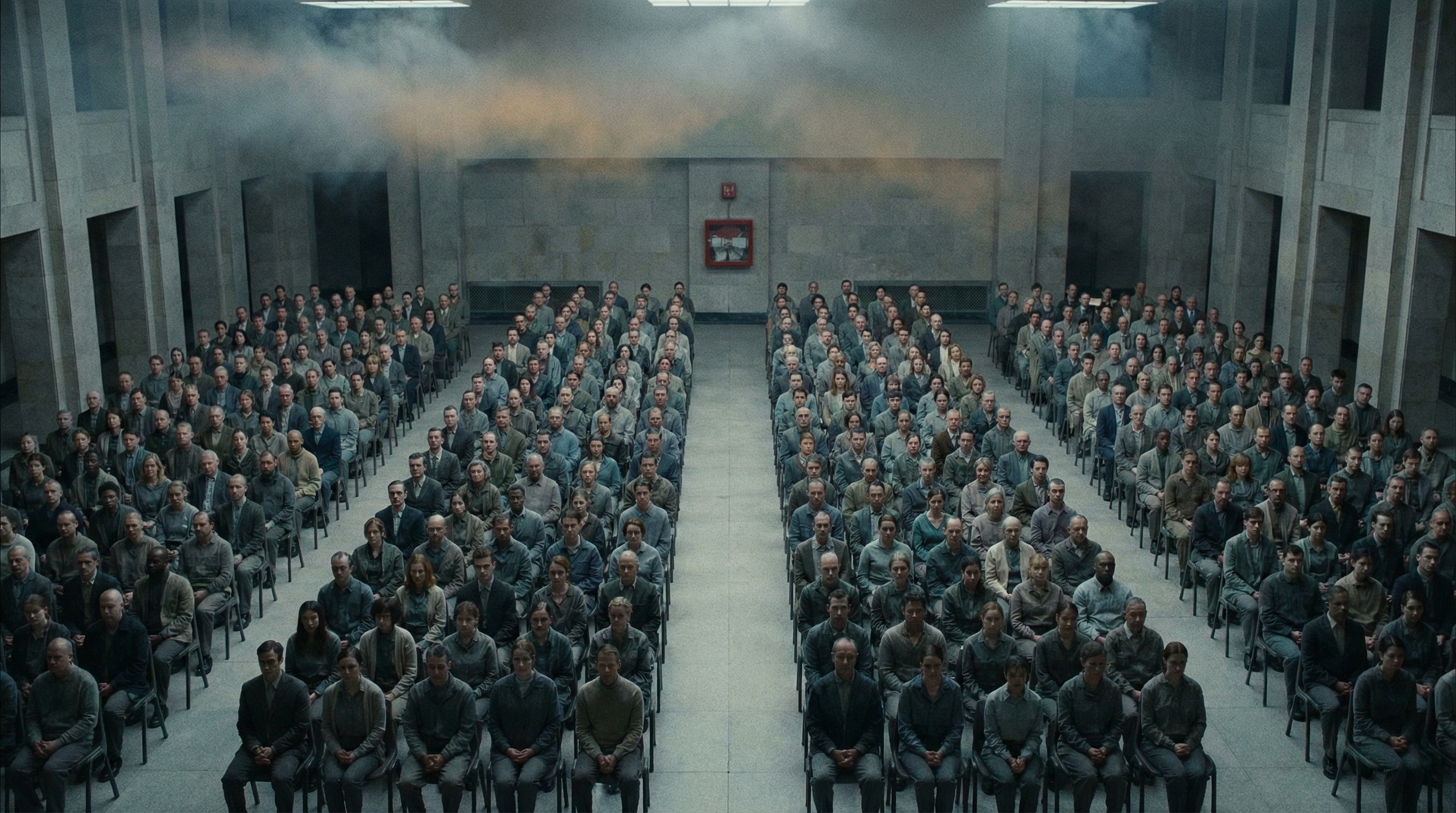
Civilizations are not destroyed by the strength of what is wrong. They are abandoned by the silence of those who know better and elect, quietly and repeatedly, to say nothing.
This is not a comfortable argument, which is precisely why it needs to be made. The comfortable arguments about civilizational decay point outward: at the corrupt, the greedy, and the hateful. These are real and they cause real damage, but they are not the primary mechanism of collapse; they have always existed. Every era produces its share of people willing to cause harm for personal advantage. What determines whether a civilization holds or falls is not the presence of those people. It is the response of everyone else.
The everyone else is the argument. The vast, quiet majority who know something is wrong and have decided, individually and separately but in aggregate catastrophically, that saying so costs too much. Greed, hate, and ignorance are symptoms. The disease is the decision, made by millions of ordinary people in millions of ordinary moments, to prioritize their own comfort over the consequence of honesty.
This decision does not feel like cowardice from the inside. It feels like wisdom, like the mature recognition that not every hill is worth dying on. Pragmatism dressed in the vocabulary of discernment. The rebranding is the mechanism. The cowardice only works at scale because it has learned to wear the costume of virtue, and the costume is convincing enough that the person wearing it frequently cannot see what is underneath.
What the Cowardice Wears
The lie told to keep the peace does not feel like a lie. It feels like kindness.
The nod given to something false to preserve a professional relationship does not feel like capitulation but like tolerance, the sophisticated understanding that people hold different views and that insisting on your own is arrogance.
The silence maintained in the presence of something visibly wrong does not feel like abdication; it feels like staying positive, like the spiritual maturity of refusing to engage with what you cannot change.
These are the costumes. Each one is tailored to a specific social environment and carries the precise vocabulary of that environment's stated values. In progressive spaces, avoidance becomes inclusion. In professional spaces, it becomes neutrality. The family setting has its own conversion: we do not bring that up because we love each other and love does not cause scenes.
The person inside each of these costumes is doing the same thing: avoiding the discomfort of honesty at the cost of the thing that honesty was protecting. The costumes make this invisible. They make the avoidance feel not only acceptable but admirable, which is how the cowardice scales. It is not practiced in shame but with a sense of virtue that insulates it from examination.
This is the rot. Not the evil that announces itself and can therefore be opposed. The virtue-costumed cowardice that cannot be opposed because it does not present a visible target, that accumulates across millions of daily decisions without ever producing a single dramatic moment where a choice was clearly made, and that ends in the same place that open cowardice ends: a room where the wrong thing won because the right thing found the cost of speaking too high.
The Planet of Actors
What the accumulated silence produces is a civilization of performance.
Leaders who do not lead. They survey. They commission research, triangulate between constituencies, read the data on what position is survivable, and adopt that position with the confidence of someone who has actually decided something. They have not decided anything. The crowd gets measured and returned to itself as a reflection, which the crowd then applauds as leadership because it confirms what the crowd already believed. The leader's spine has been replaced by a feedback loop, and the loop runs perfectly as long as the crowd's preferences do not require confronting anything real.
Citizens who do not think. They recite. Information confirming the position of their chosen group gets selected, repeated in that group's vocabulary, and called independent thought once it has circulated long enough. Genuine thinking is uncomfortable. It produces conclusions that do not always align with the group's positions, which creates the social risk of being seen as disloyal, which costs more than most people are willing to pay. Recitation is safe and earns applause. Applause feels like truth.
Then there is the family dinner. Everyone goes quiet because confrontation might make the holiday awkward. The patriarch whose methods were abusive, acknowledged in private and never named in public. Everyone knows about the member whose behavior is causing damage. The siblings have discussed it. None of them will address it directly. What everyone knows and no one will say gets preserved in silence by the collective agreement that the temporary discomfort of naming it outweighs the ongoing damage of not naming it. This agreement is renewed at every gathering. The damage compounds.
The specific geometry of collective abdication works as follows: each person's inaction is sustained by the inaction of everyone around them, which makes each person's inaction feel reasonable, which sustains everyone else's. The structure is self-reinforcing. No coordination is required, only the shared human preference for comfort over consequence, applied simultaneously by enough people that no individual experiences themselves as making a choice at all.
When Reality Stops Mattering
The sequence that follows from sustained collective silence arrives not as a single visible rupture but as a gradual substitution, one layer at a time, of what is real with what is preferred.
Truth becomes too expensive to state clearly, so people state it with softening qualifiers until the qualifiers consume the truth. The truth that was in the center of the statement is now surrounded by so many accommodations for the feelings of people who do not want to hear it that it can no longer be identified without effort. Over time the effort stops being made. The qualifiers remain. The truth they were protecting disappears.
Propagandists did not build this alone. It is the cumulative work of every person who chose a coherent story over an inconvenient reality, every institution that protected its reputation over its accountability. Communities do the same: they prefer their self-image to an accurate account of what they are actually doing. The narratives are maintained not by force but by collective investment of people who need them to be true and have the social power to discourage examination.
Feelings replace standards. Standards are uncomfortable because they apply regardless of how anyone feels about them. When the general preference for comfort overrides the maintenance of standards, standards begin to flex around the feelings of whoever is most vocal about having them. The standard that applied to everyone now applies to everyone except the people whose feelings make the application inconvenient. It has not been abolished but quietly made meaningless, which is more useful to the people who needed it gone.
Into the space left by absent truth and absent standards, accountability having been quietly retired long before, moves the most shameless person available. Not necessarily the most capable, not the most deserving by any measure that would have mattered when standards were intact. The most shameless. The one willing to say the thing others will not, to occupy the space others have vacated. The restraint that the silent majority is still practicing, long after the conditions that made it sensible have dissolved, does not apply to this person.
This person ends up in control because no one with a spine was willing to pay the price of using it. The shameless did not defeat the principled. The principled defeated themselves, one comfortable silence at a time, across a period long enough that no single moment felt like a turning point.
The Virtue That Is Not Virtue
The visibly corrupt are not the primary problem; they are few, identifiable, and their existence predates every civilization that has managed them successfully. The primary problem is the people who consider themselves good, who have genuine values, and who would be deeply offended by the suggestion that their behavior is cowardice. They are nonetheless participating in the same collective abdication as everyone else through their practiced, socially rewarded avoidance of every situation that would require them to pay a real price for what they claim to believe.
The lie told to keep the peace is still a lie. The nodding along to something false is still an endorsement of the false thing regardless of the internal reservation. Nothing is more reliable to the wrong than the silence of people who know better. It requires no maintenance, carries no social cost, and can be sustained indefinitely by people who experience themselves as blameless throughout.
Cowardice that knows what it is remains a limited thing. It is aware of what it is doing and capable, in principle, of choosing differently. The version that has convinced itself it is wisdom, pragmatism, or maturity has removed itself from the possibility of that choice. The person wearing the virtue costume is not making a decision to be cowardly; they are making a decision to be reasonable, and they will continue making that decision, in every room, at every moment that requires something more expensive, for as long as the costume remains convincing.
The costume is convincing because the social environment rewards it and because the person wearing it is surrounded by others wearing identical ones, which makes it appear to be simply how thoughtful people dress.
The Price of Silence, Calculated
People who choose silence over consequence imagine they are choosing not to pay. They are not choosing to abstain from payment; they are choosing which price to pay and deferring the larger one to a future they will share with everyone else.
The price of speaking is immediate and personal. Social friction. Professional risk. What the honesty costs the relationship is real and borne immediately by the person who spoke.
The price of silence is collective and cumulative and arrives on a timeline long enough that no single person experiences themselves as having caused it. It is the civilization that has lost the habit of truth-telling, the institutions that no longer function because accountability became optional. Standards do not survive when enforcement is reserved for convenient moments. The room ends up controlled by the shameless because the principled found the price of the room too high.
That price is not paid in a single dramatic moment; it is paid in the compound interest of every silence that made the next one easier, every abdication that normalized the next, until the thing that was not being said became the only thing that mattered and it was no longer possible to say it safely.
The house is not burning because no one smelled it. Everyone smelled it. The house is burning because the people who smelled it looked at the cost of pulling the alarm and decided that the cost was someone else's to pay.
Who Pulls the Alarm
The world does not need more people who are aware. Awareness without action is simply informed spectatorship, and the stadium is already full.
What the moment requires is the specific, costly, unglamorous decision to say the true thing in the room where it is unwelcome. Not online, where the audience is selected and the cost is managed. In the actual room. At the actual table. Where the false thing is being stated with confidence and the true thing would create friction that everyone present would prefer to avoid.
This is not a call to aggression or to the performance of bravery; it is a call to the simple, repeated, daily practice of refusing to endorse what you do not believe, refusing to validate what you know is wrong, and withdrawing the silence that has been serving everyone's comfort at the expense of what is real.
The alarm is not a dramatic gesture. It is the accumulation of moments where a person chose honesty over comfort, consequence over the peace purchased at reality's expense. Each one costs something. Each one also does something: it makes the next one slightly less expensive, for that person and for everyone watching who needed to see that paying the price was survivable.
The world does not collapse from darkness. It collapses when enough people with light decide that using it costs more than they want to pay.
The smoke is in the room. The question is what you intend to do with what you are smelling.