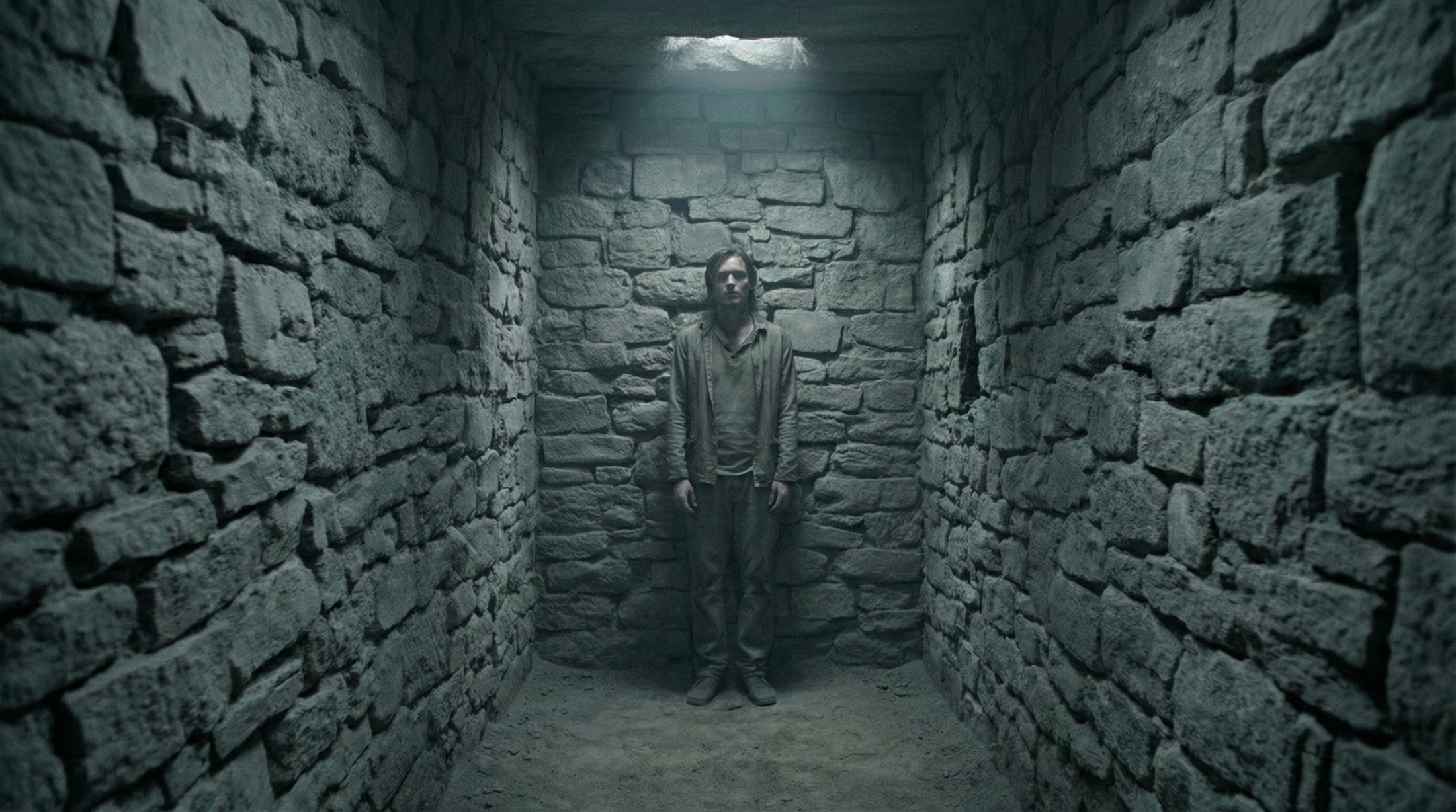
Most people who believe they are trapped are not trapped; they are entombed: sealed inside a structure they built themselves, from materials they chose, over a period of time long enough that the construction became invisible.
This distinction matters more than it appears to. A trap implies an external mechanism: something built around you by a person or a system outside your control. A trap has a trapper. It has a lock that someone else holds the key to. Something that happened to you, which means the exit requires something to be done to it from outside.
A tomb is different; it is sealed from the inside. The person inside it built every wall, placed every stone. Every material was their own choice. No warden exists. No external lock requires picking. The architecture surrounding the person is entirely their own work, constructed over years through the accumulation of small choices that individually felt like wisdom and collectively became a prison.
The person inside a trap is a victim of something; the person inside a tomb is its architect. That is not a comfortable distinction. It is the only honest one, and the only one that points toward an actual exit.
What the Walls Are Made Of
The tomb is not built in a single decision. No person wakes one morning and chooses to seal themselves inside a life too small to breathe in. The construction is slower than that, and quieter, and it wears the face of reason at every stage.
The walls are made of hesitation. The accumulated residue of every moment a person stood at a threshold and stepped back from it. The step back occurred without drama, without the full awareness that a refusal was taking place, driven instead by the mild, self-convincing logic of not yet, not until the conditions improve. Each hesitation deposits a small amount of material. Over months and years that material solidifies. What began as an open question, a possibility held loosely, hardens into a wall the person eventually stops noticing because it has always been there.
The walls are made of refused chances. The opportunity not taken because the timing felt wrong, because the risk felt too large. Someone else seemed better positioned. The comfort of the current arrangement outweighed the appeal of what the chance offered. Each refusal is rational in isolation. The sequence of refusals, accumulated across a decade, becomes a record of a life that preferred its own continuation to its own expansion.
The stories a person tells to explain why the walls exist are the mortar. I am waiting for the right moment. I am being responsible. The third story is the quietest and the most complete: that is simply not the kind of thing someone like me does. These stories hold the stones in place. They transform what is actually a series of fear-driven retreats into a coherent philosophy of caution, a self-concept built around prudence rather than paralysis. The narrative that results permits the person to inhabit their tomb without recognizing it as one.
The builder never experiences the construction as construction. They experience each individual stone as a sensible choice. By the time the structure is complete, they are standing inside it wondering why they feel so confined.
The Comfort Trap
The body registers comfort as safety. The mind accepts that registration as wisdom. This sequence is the mechanism of the trap, and it operates below the level of conscious examination in most people.
When a situation is familiar, when the risks are known, and the outcomes have stopped requiring any real navigation, the nervous system signals that the environment is manageable. That signal feels like security, like something worth protecting. The mind, reading that signal, calls it the result of good decisions, the feeling of being safe.
What it actually feels like is the absence of challenge, which is not the same thing as the presence of something worth having. The distinction is critical and it is almost never made, because the body cannot feel the difference between genuine security and the sedation of a life too small to require full capacity.
Safety, pursued as an end rather than used as a foundation, becomes a slow kind of death. The slow kind, without urgency or announcement, the kind that stretches across decades disguised as stability, consuming the person's days in manageable increments while returning less and less of what a life is supposed to feel like from the inside.
The comfortable person rarely feels the consumption in real time. They feel it in accumulation: the vague dissatisfaction that has no specific object, the sense that something is wrong without anything being obviously wrong. The life looks reasonable from the outside and registers as suffocation from within. They try to address it with adjustments: a new purchase, a minor change in routine, without naming what is actually causing it, because naming it would require admitting that the comfort they have organized their life around is the source of the problem rather than its solution.
The Elegant Rot
There are two ways to be consumed by time. One is violent and visible. The other is managed and invisible until the damage is too complete to reverse.
Most people choose the second without knowing they are choosing it. They select the life that photographs well, that requires no uncomfortable explanation, that allows them to sit at any table and report a respectable version of how things are going. They maintain the performance of a life in motion while standing, underneath the performance, entirely still.
This is what elegant rot looks like from the inside. The career that is technically progressing but has not required genuine stretch in years. The relationship that is technically intact but has not produced genuine intimacy in longer than either person will admit. The self that calls its repetition development because nothing unfamiliar enough to produce actual change has been allowed near it. Everything is fine. Nothing is alive.
The person rotting elegantly is not obviously failing, not visibly struggling. They are simply declining at a rate too gradual to register as decline from inside the experience of it. A decade passes. Another follows. The walls of the tomb are no closer than they were ten years ago because the person has not moved toward them, but they are no further either. The dimensions of the life have not changed. Only the amount of time remaining to change them.
Time does not negotiate and does not offer extensions for people who were comfortable. It takes everyone, at its own pace, on its own schedule. The only variable it permits is whether it takes you while you are moving or while you are standing still. Whether the life it eventually concludes was spent burning through the walls or decorating them.
Consent or Defiance
Burning violently is not a metaphor for recklessness; it is a metaphor for the decision to move despite the discomfort of movement, to take up space despite the risk of being wrong. Refusing the slow consumption of a life organized around the avoidance of the fall is what both of those decisions are ultimately for.
The fall is real. This is not a promise that risk produces reward, that everyone who breaks their walls reaches something worth breaking them for. Some break through and find open air. Others find harder ground. The breaking is not a guarantee of anything except the one thing that staying sealed inside guarantees the absence of: the knowledge of what is actually on the other side.
The person who never takes the fall never resolves the question. They spend the remainder of their life inside the tomb, managing their comfort, maintaining their surface. In the quiet hours they wonder what would have happened if they had moved when movement was available to them. The wondering does not fade. It calculates compound interest. By the end, it is the loudest thing in the room.
Defiance is not the absence of fear. The walls feel real even when they are made of hesitation rather than stone. The height of the threshold feels genuine even when the danger on the other side is smaller than the danger of staying. The decision to move in the presence of that fear rather than in its absence: that is what defiance requires, because waiting for the absence of fear before moving is another name for staying inside the tomb.
Consent is the alternative. The agreement, never formally made but functionally complete, to allow time to take you on its own terms, inside the architecture you built, without the disruption of having actually tried. It is a peaceful arrangement. It is a complete surrender of the life that was available.
The Exit Was Always There
The tomb has no lock on the outside. It cannot. It was built from the inside, which means the only mechanism that exists for opening it is interior.
This is the most uncomfortable feature of the architecture. An external lock permits the fantasy of an external solution: the right opportunity, the right circumstances that will finally make movement feel safe enough to attempt. The person waiting for that external solution is waiting for something that will not arrive, because the solution was never external. The door was always on their side of the wall.
Breaking through requires only one thing, which happens to be the one thing the tomb was specifically designed to make unavailable: the willingness to move before the conditions feel safe. Before the timing is right. Before the outcome is known. Without any guarantee that the fall will not hurt.
Those conditions never arrive. Safety, as a precondition for movement, is a standard that can never be satisfied, because the only way to know whether movement is survivable is to attempt it. The person waiting for certainty before they act is waiting for a product that is not manufactured. Certainty about outcomes is not available for purchase. The only available choice is to move into uncertainty or to remain in the structure that uncertainty built.
Most people, faced with that choice, redecorate. They rearrange the furniture inside the tomb, improve the lighting. They make the space more comfortable and call the renovation growth. It is not growth but investment in the interior of a structure that is still sealed. Nothing has moved except the furnishing.
What the Ground Teaches
The ones who fear the fall never learn the air. They learn the ground instead, with great thoroughness and over a very long time. They master the terrain of the tomb, its dimensions, the particular quality of its silence. The space that was supposed to be a departure point becomes the terrain they know best.
Mastering dying on the ground is still dying. The expertise is real and so is the achievement. The walls are still there.
What the ground cannot teach is what the fall teaches: that the body knows how to move through open air, that the thing feared is survivable. The life on the other side of the wall is not identical to the life inside it. That information is not available to the person who stays; it is only available to the person who goes, who breaks through the material of their own hesitation and finds out what was actually on the other side of it.
The choice is not between safety and danger. Both roads contain danger. The tomb is dangerous. Stagnation is a form of damage as real as any external harm, slower in its arrival and more complete in its consumption. The choice is between a death that happens to you, gradually and elegantly, inside walls you built and decorated and called a life, and a life that happened because of you, not to you: imperfect, ungraceful in places, and genuinely yours.
The walls are made of your own material. That means you know exactly what they are.
Break through them.