The most effective manipulation does not require the manipulator to deny what they did; it only requires them to make your response to it the subject of the conversation instead.
This is the mechanism behind one of the most common and least examined forms of relational control. The pattern has been stated plainly: manipulation is when they blame you for your reaction to their disrespect. The observation is correct as far as it goes. What it does not go far enough to explain is why the mechanism works, how it is constructed, and who it works on most effectively. The cost to the person inside it who cannot yet name what is happening to them is what this examination is for.
The manipulator in this scenario does not need to be a villain in any dramatic sense. They do not need a conscious strategy or a deliberate plan. What they need is the instinct, honed over years in most people who operate this way, to redirect attention away from their own behavior and toward your response to it, the moment your response creates a problem for them. The redirection is the mechanism. Everything else follows from it.
How the Spotlight Moves
The sequence is precise and it repeats.
First, the provocation. An insult delivered with a calm face. A dismissal wrapped in reasonable language. Contempt practiced long enough that it has stopped looking like contempt and started looking like honesty. The disrespect lands. It was designed to land. Whether the design was conscious or habitual is irrelevant to its effect.
Then the reaction. You respond to the thing that happened. Your response carries the heat of what it responded to: it carries the evidence. Your voice, your expression, your words in that moment are the exact shape of the wound they made. They are proof that something occurred.
Then the redirection. The spotlight moves. Not slowly, not subtly, but with the practiced speed of someone who has done this before and knows exactly when to move. What they did is no longer the subject; what you did in response to it is now. Your heat is the problem now, your reaction the thing that requires explanation. The wound itself has been quietly removed from the frame, and what fills the frame instead is your response to it.
The person who caused the harm is now studying your reaction like it is the crime. They are not defending the disrespect. They are not addressing it or acknowledging it. They are examining your response to it with the careful attention of someone building a case. Evidence is being collected. Your instability, your disproportionate response: all of it is being documented, including the inability to handle a simple conversation without escalating. They are writing the record that will be consulted the next time an account of events is required.
The guilty party has clean hands. The person who was harmed is holding all the evidence of the harm.
The Trial That Was Never Announced
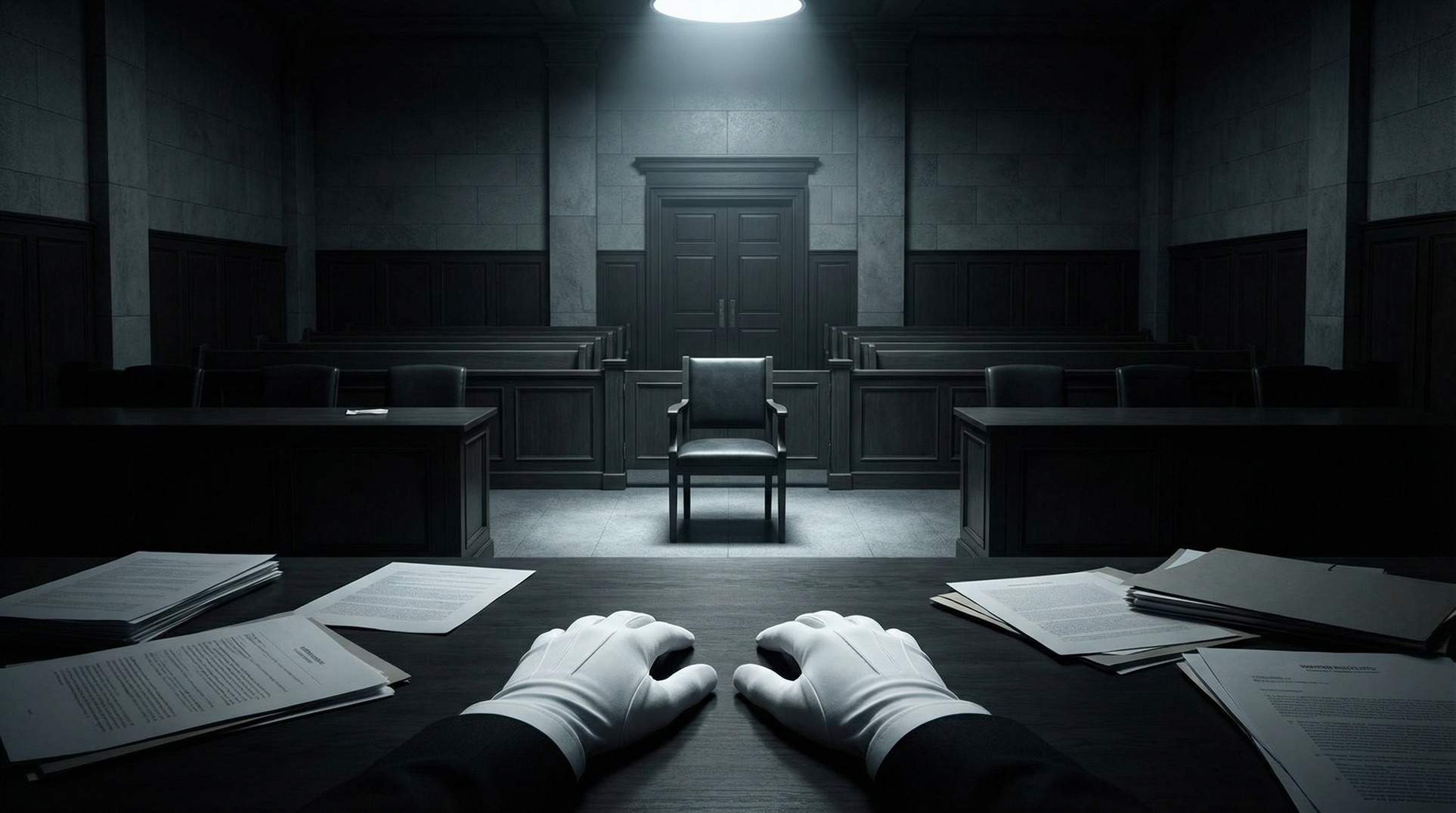
The courtroom is the relationship itself, and the rules of evidence were written before you arrived, by the person with the most to hide. The rules are these: your pain is inadmissible, your reaction is exhibit one. The burden of proof falls entirely on the person who was harmed to demonstrate that the harm was real and the response to it was justified.
One day, mid-argument, you simply found yourself inside them, realizing that the conversation had moved somewhere you did not intend to go and that you could not locate the moment it moved. You never agreed to these rules. You were not consulted when they were written.
That disorientation is not accidental. It is the product of the mechanism working correctly. The shift from what happened to how you responded happened fast enough and smoothly enough that you lost the thread of the original subject before you could secure it. Now you are explaining your reaction. Now you are defending your emotional response. The case you are making is that the way you felt was understandable given the circumstances, and the person across from you is listening with the patient skepticism of someone who has already decided that the circumstances, as you have described them, do not hold up.
They are not confused about what happened. They wrote the rules of this courtroom precisely because they understood what happened and needed the record to say something different. The furrowed brow, the genuine-seeming bewilderment at why you are so upset: none of this is confusion. It is the continuation of the strategy by other means.
The confused person asks what they did. The manipulator asks why you are reacting this way. That difference is the tell. One question is oriented toward the cause; the other toward burying it.
Who the Trick Works On
The mechanism does not work equally on everyone. It works best, and most completely, on a specific kind of person: the one who was trained early to doubt the authority of their own pain.
This training takes many forms. The household where composure was the highest virtue and emotional response was treated as weakness or imposition. The relationship that required the performance of fine regardless of what fine actually felt like. What followed, across years, was having pain named and then immediately reframed by someone with more authority, until the naming and the reframing became internal, until the person learned to reframe their own pain before anyone else had to do it for them.
These people carry a specific vulnerability into their relationships. They have been taught, at a level below conscious decision, that their instincts about being harmed are less reliable than the calm account of the person who harmed them. That composure carries more credibility than distress, that the person who maintains their surface is probably telling the truth. The person who has lost theirs probably is not.
This installation is what the mechanism runs on. The manipulator does not install it; they simply find it already in place and operate it. They present themselves as calm. They frame your reaction as disproportionate. What follows is the wait. The training activates because it was built for exactly this moment: the moment when your pain is presented as the problem and your composure-trained mind begins to wonder whether they might be right.
The editing begins. You soften the account. You qualify the anger. The instinct that told you something was wrong gets quietly retired. The wondering begins: whether being harmed was less offensive than noticing it. The architecture of control does not require force at this stage. You are doing the work yourself, with tools that were placed inside you long before this person arrived.
The Architecture of Control
The full cycle has two stages, and the second stage is the one that makes the first stage permanent.
The first stage is the violation. What follows is the punishment. The disrespect, the provocation: this establishes the terms: there are things that will be done to you in this relationship, and they will not be acknowledged as things being done to you.
Not the punishment of the violation; that would require acknowledging it. The punishment of the reaction to it. You are not being penalized for what they did; you are being penalized for proving it happened. Your reaction is the evidence of the boundary, and your punishment for it is the instruction that the boundary is not permitted to exist.
This is the architecture of control at its most complete. First they violate the boundary. Then they punish you for proving it existed. Over time, if the cycle repeats without interruption, the person inside it learns to skip the reaction. They learn to absorb the violation without visible response, because the visible response costs more than the violation itself. They have been trained, through the systematic punishment of their own instincts, to police themselves on the manipulator's behalf.
By this stage, the control is total and the manipulator has never had to raise a voice or apply visible force. The person being controlled is applying it themselves. Their self-respect has been negotiated into silence through a process they participated in without understanding what they were participating in.
That is the architecture. See it whole and it loses some of its power. Name the stages and you interrupt the automation.
Their Confusion Is Theater
This requires stating plainly because it is the point where most people inside the mechanism lose the most time: the manipulator already understood the match.
They are not confused about why you are upset. They know why you are upset. Precision is what caused it, and they watched it land. The performance of bewilderment, the genuine-seeming question of why are you so sensitive, the patient explanation that they did not mean it that way, that you always do this. You take everything too personally: none of this is confusion. It is the continuation of the strategy.
You cannot explain the fire to the person who lit it. They know what fire does. They chose the match. The explanation you are attempting to provide is not information they lack. It is a performance they are directing, and every sentence you spend justifying your reaction is another sentence in which the original subject is not being discussed.
The investment in making them understand is not wrong in its origin. It comes from a legitimate place: the belief that if they understood the harm clearly enough they would stop causing it, that the problem is comprehension rather than intention. This belief costs you the most time and the most self-respect, because it keeps you in the courtroom making the case, accepting a burden of proof that was never yours to carry. The person who wrote the rules watches the trial they designed proceed exactly as planned.
They understood. They chose anyway. What they are performing is the doubt in you, not the uncertainty in themselves.
Step Out of the Reach
The task is not to convince them; it is to see the mechanism clearly enough that it loses its grip.
This is harder than it sounds, because the mechanism was built to resist clear seeing. The training that made you doubt your own pain does not dissolve the moment you name it. The instinct to explain, to justify your reaction to the person who designed the case against you does not quiet immediately. It has years of practice. It has been reinforced every time the explanation failed and you concluded that the failure was yours rather than the mechanism's.
Clear seeing does not change the mechanism; the mechanism continues to operate. What changes is your position relative to it. You stop standing inside the courtroom accepting the burden of proof and you start standing outside it, watching the trial run without a defendant.
When they make your pain the problem, they have already confessed the strategy. The confession is in the redirection itself. A person without something to hide does not need to move the spotlight. Punishing your reaction is only necessary for someone with an interest in your silence. The mechanism announces what it is, every time it runs, to anyone who knows what they are looking at.
See it. Name it. The sentence you were about to spend explaining the fire to the person standing at the origin of the flame belongs somewhere else.
Your self-respect is not a negotiating position and is not available for debate. It does not require their agreement to be real, nor their acknowledgment of the harm to justify your response to it.
The wound was real. The reaction was accurate. What the mechanism was designed to do is make you doubt both of those things.
It was always theater. You were always the audience they needed.