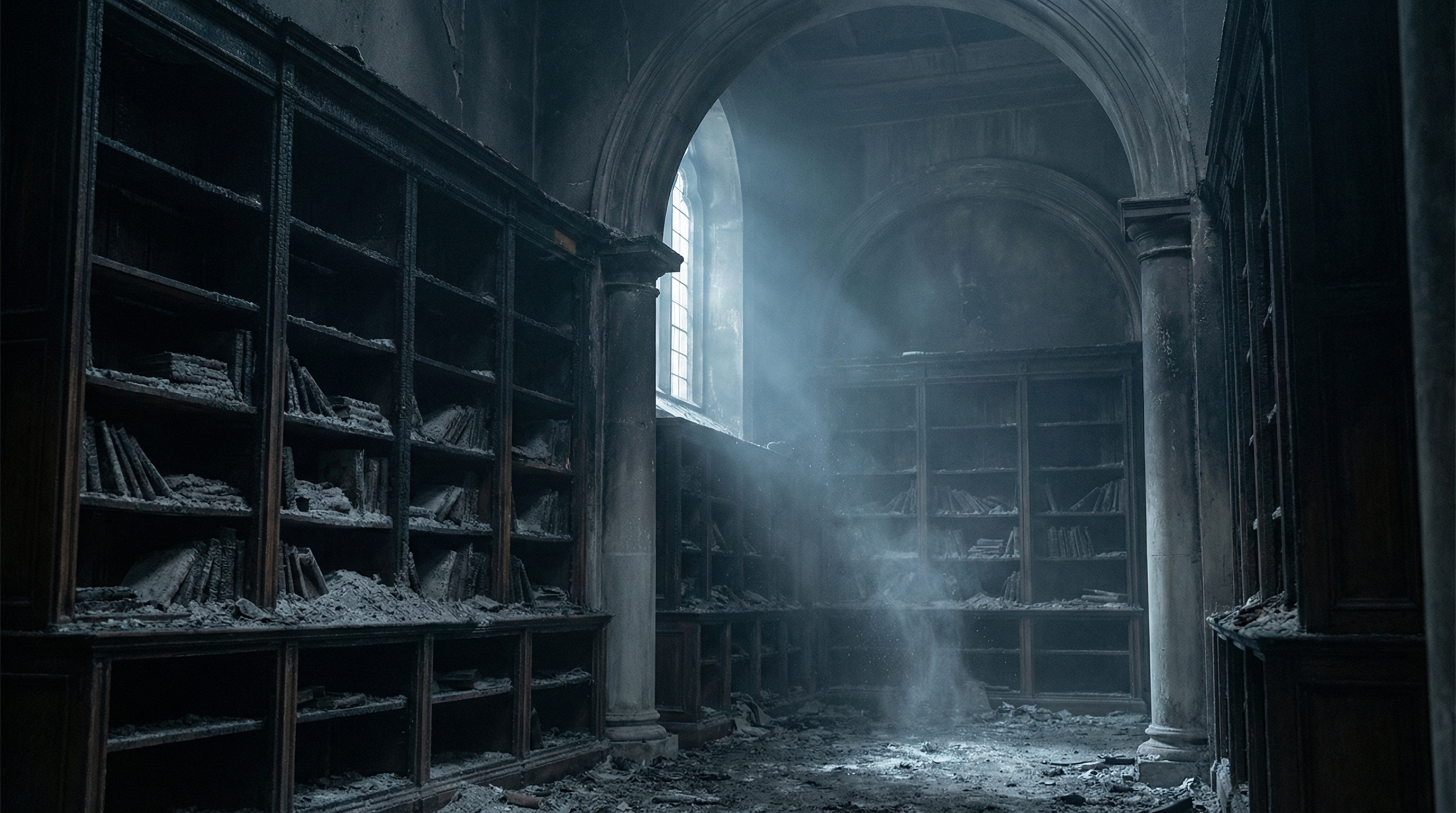
When an old person dies, the world does not simply lose a life. It loses a private library: a singular accumulation of lived knowledge, refined judgment, and irreplaceable method that was never written down and now never will be.
Ray Bradbury understood this with a precision that most grief cannot find. When his grandfather died, he wrote that he was not crying for the man himself but for all the things the man had done and would never do again. The wood never carved. The pigeons never raised. The jokes never told in that specific voice, with that particular timing that belonged to no one else. The world, he said, was bankrupted of ten million fine actions the night his grandfather passed. The bankruptcy was literal, not metaphorical: a debt was incurred, a withdrawal was made from a balance that had no recovery mechanism, and the account closed permanently with nothing transferred and no recovery possible.
This is the correct way to understand what an old person's death costs. Not the loss of a body, not the conclusion of a timeline, and certainly not what people mean when they say it was natural, as though nature completing a process removes the cost of what it takes. The bankruptcy of an irreplaceable account, the burning of a library that had no copies.
The people who speak casually about elderly death, who measure it against current utility and weigh the frailty against the output until the math no longer seems to work, have revealed something about themselves that they have not examined. They understand production. They do not understand inheritance. The present balance of a life is legible to them. The accumulated interest of everything that life deposited into the world before they started paying attention is not.
What Current Utility Misses
A person is not only what they are doing now.
This seems obvious until it is tested by the sight of someone old and slow and near the end of their visible usefulness, at which point it becomes a principle that a surprising number of people quietly abandon. The frailty becomes the data. The slowness becomes the summary. What remains of their production gets filed as evidence that the meaning was always, primarily, in the producing.
It was not. It never was.
A person is the full pattern of what they have done to the world. The shape they left in every person they knew, in every place they occupied, in every situation they entered and changed by being in it. The habits they modeled before anyone knew they were watching. The restraint they exercised in moments that required it and that no one witnessed. How they responded to difficulty, observed by children and carried into those children's adulthood and from there into the adulthood of children not yet born.
A person is the stories they told and the stories they were. The craftsmanship they practiced until it became invisible, until the quality was simply expected because it was always there. The moral gravity they carried, not proclaimed, not performed, but present, felt, orienting everyone in the room without anyone quite being able to say how. Humor entirely their own, calibrated to decades of specific experience, landing in ways that no one else's humor landed because no one else had lived exactly that accumulation of days.
Current utility measures none of this; it cannot. What it offers is a snapshot, nothing more. A person is a library, and you cannot read a library from a snapshot of its exterior on a day when the doors are closed.
The Private Library
Every person who has lived long enough to become old has built something that has no institutional equivalent and no backup system.
A public library has a catalog, copies, records, redundancies, and systems for preservation and recovery. When a public library is damaged, the loss is assessed, the inventory is taken, and the recovery begins from what remains. The knowledge was recorded. That record survives even when the building does not.
A private library operates entirely differently. It was never cataloged because its owner did not experience it as a collection. It was simply living: the accumulated residue of every book read and lesson learned and mistake made and recovered from and person loved and lost and understood more clearly in the losing. The organization of this library follows a logic that existed only in the person who built it: an associative, experiential logic that cannot be transferred in its organizational form, only in fragments, through conversation and demonstration and the slow transmission of proximity.
What the private library holds is not facts. Facts can be looked up; they survive the person. What it holds is method. The specific way of seeing a problem that was developed through sixty years of encountering problems and being wrong about them and being right about them and learning, over time, which approaches tend to produce which results in which kinds of situations. The judgment that is not a rule but a felt sense, refined through decades of application, that arrives faster and more accurately than any deliberate analysis because it has been practiced so many times it has become instinct.
It holds the particular way of repairing a thing, whether a broken object, a broken relationship, or whatever in a person has come apart and resists the usual approaches. The specific patience of it. The specific refusal to give up on what others would have discarded. The understanding of what a thing needs to become whole again, developed through a lifetime of having repaired things and having been repaired.
It holds the humor. Not jokes. The sensibility behind them. The angle from which life looked absurd to this specific person, in this specific way, which made them laugh at things no one else laughed at and find comfort in observations no one else would have thought to make. This sensibility was constructed by an unrepeatable sequence of experiences. No description reconstructs it. It can only be received in the presence of the person who carries it, and when that person goes, the sensibility goes entirely.
What Burns With the Library
When the library burns, the catalog burns first.
The catalog is the organizing logic: the connections between things, the cross-references, the internal architecture that made the knowledge navigable. Even if fragments survive: a story told to a grandchild, a technique passed to an apprentice, a phrase lodged in someone's memory long after the person who said it was gone. They survive without the system that gave them their full meaning. They survive as isolated volumes pulled from a burning building, legible in themselves but severed from the larger argument they were part of.
What burns completely is the knowledge that was never articulated because it did not occur to the person that articulation was necessary. The knowledge that was simply how they did things. The morning routine that was built around a philosophy of the day that they never examined as a philosophy. The way of listening to someone in distress: the silence offered, the moment chosen to speak. These were the product of decades of learning what listening actually requires, and the person who practiced them would have been unable to explain them if asked. The standard they held without naming it, that everyone around them felt but that died with them because it lived in practice rather than in principle.
Bradbury's grandfather shaped wood. He raised pigeons. He cleaned slums. Jokes were told in a voice that will never exist again. The world lost ten million fine actions the night he died: not potential actions, not future actions, but the ongoing actions of a man who had not finished acting. He was part of the world's functioning. When he left, the part that was him stopped.
No one replaced it; it was not replaceable. It was his.
Contempt as Spiritual Illiteracy
To look at an old person and see primarily their diminishment is to confess a specific and significant ignorance.
It is the ignorance of someone who understands production but not inheritance. Who can read the present condition of a thing but not the history of what it built. Who knows what a tree looks like when it has stopped growing but does not know what its roots have been doing for fifty years in the ground beneath it: what they have stabilized, what watershed they have fed, and what ecosystem they sustain simply by existing.
A young mind that has not yet lived long enough to see the shape of a full life does not know what it is looking at when it looks at an old person. The surface condition is all it sees, without the depth of the investment beneath it. The slowness registers, but none of the weight that slowness holds registers with it. What has already been deposited into the world, operating quietly in the lives and habits and capacities of everyone the old person ever shaped, remains entirely invisible.
Contempt for the old is also contempt for one's own future. The person dismissing the elderly has not yet understood that they are waving away the thing they will become. They have not yet grasped that the arc they are on leads to the same slowness, the same frailty, the condition they are now waving away as though it were simply a failure to maintain relevance. The arrogance is particular and temporary. Time is patient with it.
What the old have that the dismissive young do not is the one thing that cannot be purchased or accelerated: the full length of the view. They have watched enough time pass to know which things mattered and which things only appeared to matter. They have been wrong in ways that were eventually corrected by time, and right in ways they were unable to prove at the moment of being right. Some of the certainties they held at thirty have been outlasted. Some of what they feared never arrived. They have seen some of the things no one warned them about arrive anyway.
This is not nostalgia. It is data, what a long life produces in a person paying attention, irreplaceable precisely because it cannot be accumulated quickly. No amount of intelligence or reading or research produces the specific authority that comes from having simply been present for enough time to see how things actually unfold.
Standing at the Full Arc
The elderly are often the only people standing close enough to the complete shape of a life to see it clearly.
From the middle of a life, the view is partial. The urgent tasks of the present crowd out the long view. The person in their thirties or forties is too occupied with the immediate arc to see the full one. The full one requires distance, and distance requires time, which is the one thing that cannot be manufactured.
The old person has the distance. They have watched their own urgencies recede. They have seen what they thought mattered give way to what actually mattered. Enough time has passed to know the difference between the things that resolve and the things that do not, between the fears worth carrying and those worth setting down, and the losses that diminish permanently versus those that create room for what comes next.
This is the particular authority that contempt for the elderly dismisses as irrelevant: the one form that cannot be faked, cannot be rushed, and admits of no substitute, the authority of having been present for the whole thing long enough to have an opinion about it that is not speculative.
When such a person dies, the world loses not only their history but their perspective on that history. The interpretation of their own arc, which no one else can provide, which dies entirely with them.
One Unrepeatable Person at a Time
The world is not emptied all at once; it is diminished one unrepeatable person at a time, in increments small enough that each individual loss can be rationalized as ordinary and natural and therefore fine. Fine is a word for transactions. A debt that clears. A balance that zeroes. A loss that finds its equivalent somewhere else and calls itself settled. Death is not a transaction. There is no offset. The unique arrangement of memory, consequence, method, and humanity that constituted this specific person does not transfer. It does not recombine. There is no reemerging in a different form. It ends, specifically and completely, and the world that continues after it ends is a world that is missing something it cannot recover.
Some of what the old person carried was passed down: in conversation, in demonstration, through the slow transmission of long proximity. A grandchild who watched closely enough. A student who paid the right kind of attention. Sometimes a community, absorbing the habits of someone who practiced them visibly over decades. These are the fragments rescued from the burning library: real, valuable, worth carrying. Fragments of the library, not the library itself.
The rest went with them.
Bradbury's grandfather never carved another piece of wood. The jokes remained untold. The pigeons went unraised in that specific, irreplaceable way. The fine actions, ten million of them by Bradbury's account, stopped the night he passed, and the world that continued after was a world that did not know, in most of its parts, what had just been removed from it.
That is what an old person's death actually is. Not a conclusion. Not a completion. Not the natural process that requires no acknowledgment simply because it was always coming. A bankruptcy. A burning. A permanent subtraction from everything the world had learned about how to be human.
No death is small. Some are quieter than others. The world loses its methods one person at a time, in the ordinary course of things, without ceremony proportionate to what was lost.
What the world owes the old is not pity but the recognition of what they carry, what it costs them to carry it, and what their departure costs everyone else. The recognition that they are not waiting to be finished, not merely the residue of what they used to be. They are libraries, still open, still holding what no other institution holds.
Go in while you still can.
When the old die, the world does not just lose people. It loses methods of being human that will never be made again.