
The Woven Ones · Dossier
Nathaniel Veritas
Woven One of Envy · The Auditor
“Look closer. That is who you wish you were.”
Layer One
Character Truth
Who He Is

Nathaniel Veritas, known within the operation simply as NV, is the Weaver’s audit, the one who clears the field of distortion before the Weaver’s truth can take hold. He specializes in the specific contamination that envy introduces into perception. Comparison thinking warps self-assessment and manufactures grievances, and it reorganizes the evidence quietly enough that the conclusion it needed arrives looking inevitable. The version of the world it produces has been rebuilt around a single question: why someone else has what the observer believes belongs to them.
His work is diagnostic before it is anything else. He locates the distortion itself. The particular comparison, the person or circumstance that has been quietly poisoning a mind’s ability to see anything clearly, the moment the wound was opened and left unaddressed. He traces it to its root with the patience of someone who has done this enough times to know that the presenting grievance is almost never the actual one. The thing a person claims to resent is usually a proxy. The real wound is older and smaller, and far more instructive for being both.
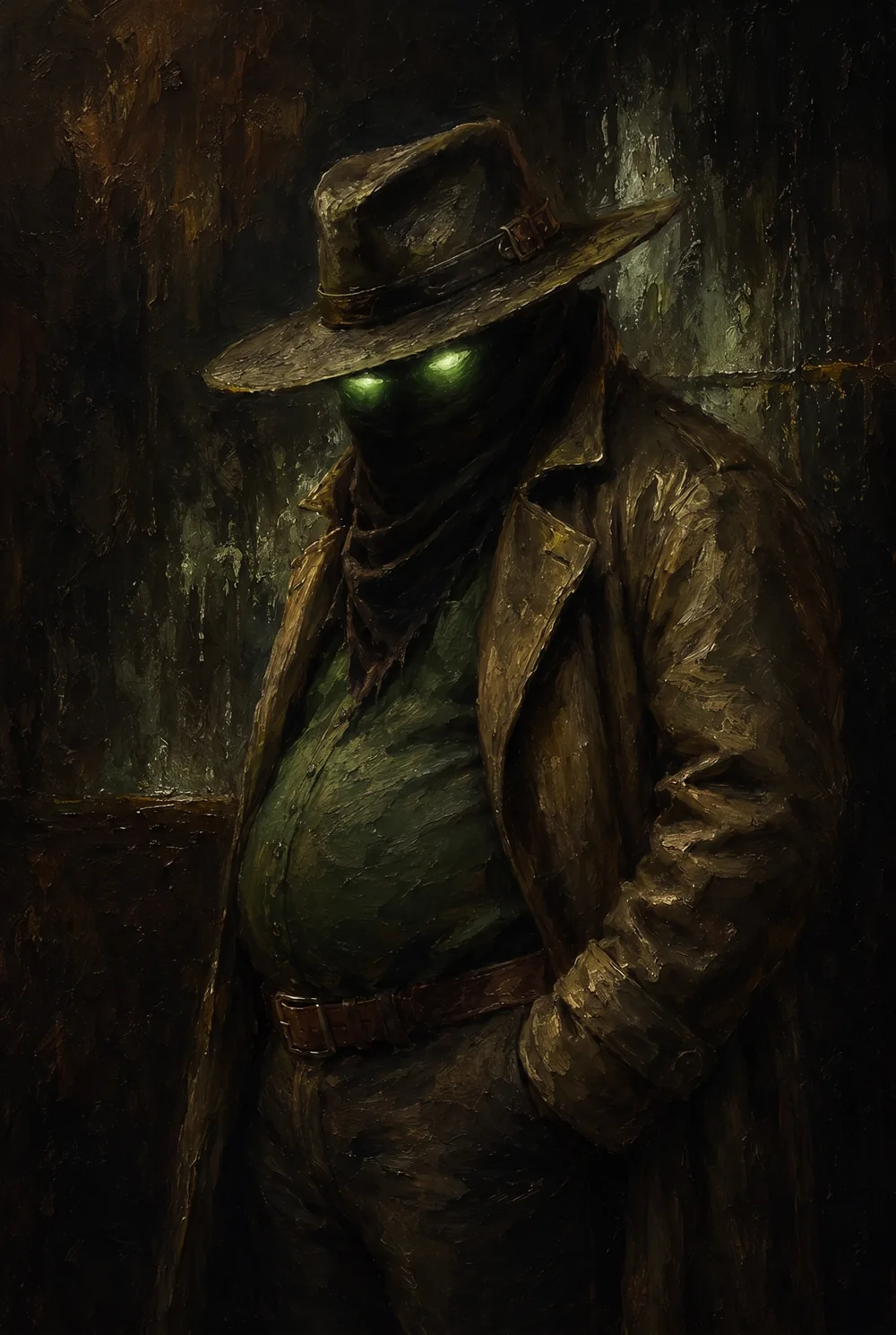
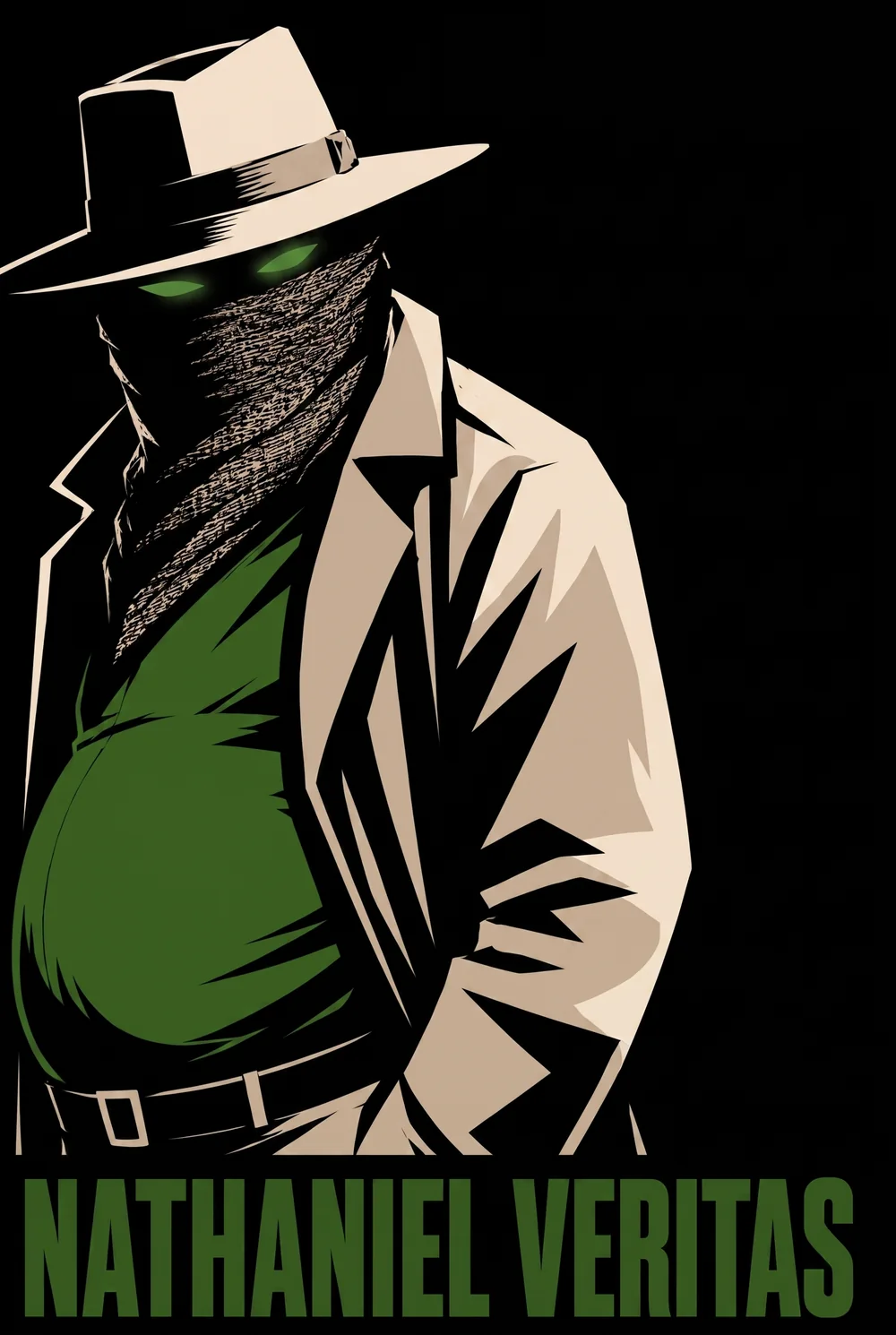
He is the most visually distinctive of the Woven Ones. He stands asymmetric, one shoulder carried lower than the other, angled perpetually toward something just outside the frame. He looks, at first assessment, like someone easily overlooked. This is the only distortion in the encounter he supplies himself. People who underestimate him based on his silhouette have already begun demonstrating exactly the kind of comparative thinking he was sent to expose.
The Auditor
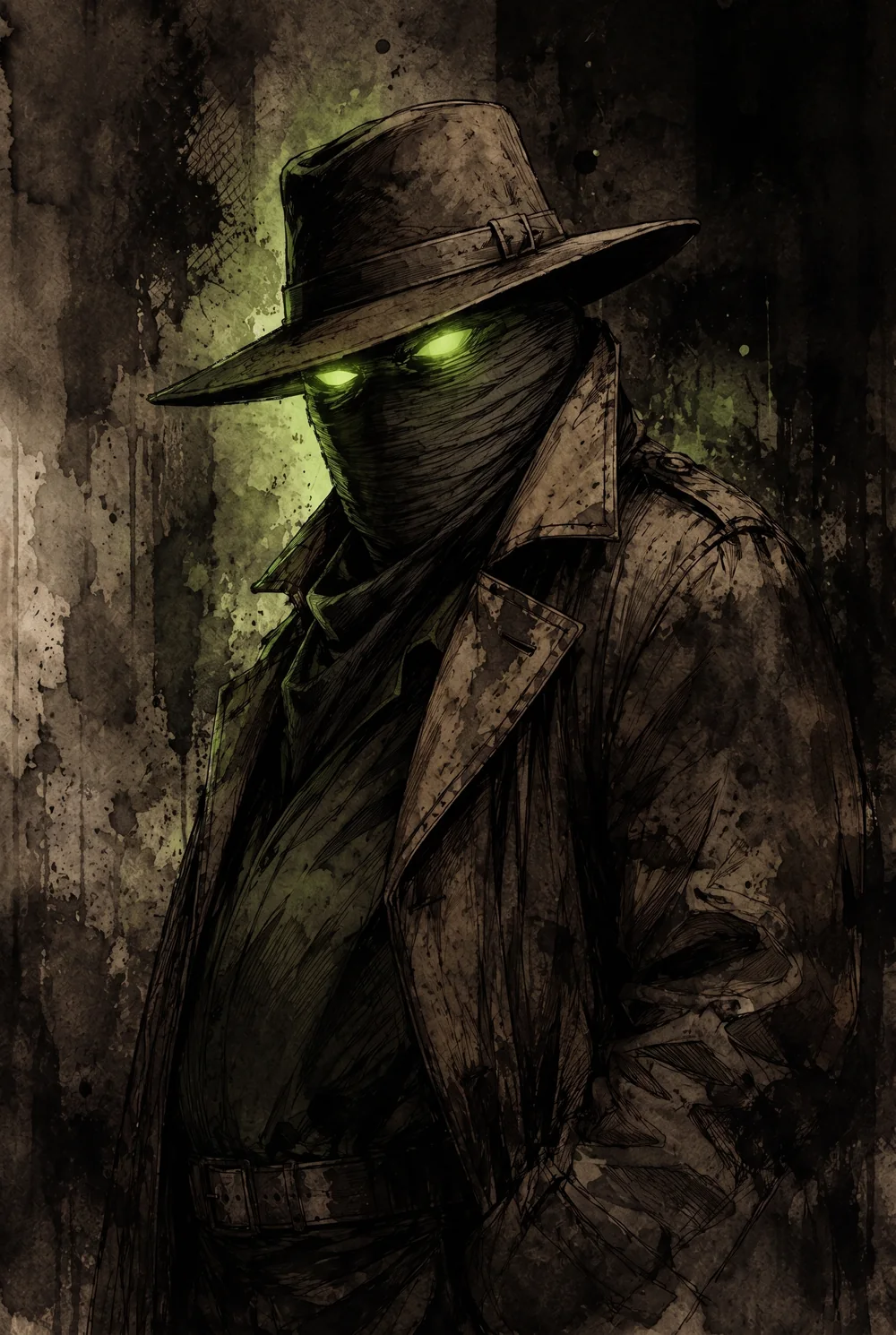
The title is precise and deliberately unglamorous, which suits him.
An auditor does not arrive to punish. An auditor arrives to examine the books, to go through every entry and every claim made about the state of things and determine what is accurate and what has been quietly adjusted to produce a more favorable picture. The audit is thorough and methodical, free of the personal investment that would cause an examiner to accept a flattering account without verification.
NV brings this same quality to the examination of how people think about themselves in relation to others. Every claim a person makes about their own worth and their own justified resentments, the whole carefully constructed account of what they deserve and have been denied, he goes through line by line. The entries that do not hold up are identified. The inflated figures are corrected. The costs that were never recorded, the things a person chose not to count when constructing their narrative of unfairness, are added back in. By the time he is finished, the books reflect what is actually true rather than what the person needed them to say in order to sustain the story they had been telling themselves.
How He Operates

He moves in bursts, quick angular steps followed by abrupt stillness, a rhythm that keeps people slightly off-balance in his presence without their being able to identify exactly why. He tilts his head sharply when he detects resentment, a small involuntary signal that the thing he came looking for has just announced itself. He mutters under his breath when he is analyzing, not loudly enough to be understood, just loudly enough to register. The person being studied becomes aware that a calculation is running and that they are one of its variables.
He stands slightly behind people rather than in front of them. Where Payne faces directly and holds position, NV positions himself in the peripheral space, the place where people are aware of being watched without being able to meet the watching directly. This positioning is deliberate. It replicates the experience of envy itself, which operates most powerfully in peripheral vision, in the thing noticed without ever being looked at directly. Envy lives just outside what a person is willing to examine.
His glow is a sickly green, the green of something organic left in the wrong conditions: present and living, but producing something toxic rather than something sustaining. It flickers when envy is present in the room, one eye slightly brighter than the other at baseline, the asymmetry intensifying when the distortion he is tracking becomes more acute. He lets out a soft breath, almost inaudible, when someone provides a false account of their own motivations. The breath is not contemptuous. It is the sound of recognition, made by someone who has heard this lie in this exact form often enough to have stopped being surprised by it.
He mirrors a person’s posture back to them during the examination, subtly and exactly, with enough accuracy to create a faint and inexplicable discomfort in the person being mirrored. It introduces a crack in the performance of self-assurance, a moment of self-consciousness that the person cannot quite locate the source of. In that crack, the comparison they have been running announces itself.
What He Represents

NV represents the specific damage that comparison thinking inflicts on a person’s ability to experience their own life directly. Envy is a perceptual condition rather than a simple wish for what someone else has. It works as a lens through which everything is filtered until nothing can be assessed on its own terms. Every achievement becomes relative. Every circumstance gets evaluated against what someone else has rather than against what is actually present. The room a person enters is ranked before they have finished crossing it, and the one doing the ranking almost never comes out on top, because the comparison was constructed to produce that result.
He represents the truth that envy is most corrosive in its quiet forms. The open resentment and the declared rivalry are the versions people recognize and defend against. It shows up when a person slightly diminishes a friend’s success in the retelling, or finds a flaw in everyone who achieved the thing they wanted. Someone else’s good news lands as a comment on their own situation rather than as news about someone else. These are the chronic, low-level distortions that NV was built to locate and extract.
He represents something the other Woven Ones do not: the particular cruelty of being underestimated. His silhouette invites dismissal and his manner invites condescension. Every person who has made that mistake has handed him a clean demonstration of exactly the distortion he came to examine. He is, in this sense, a self-fulfilling audit. The encounter itself produces the evidence.
The Original Entry

He does not name the person. What can be said is this: there was one comparison at the root of him, held long enough that his life organized itself around the other man’s coordinates. Where the other man advanced, NV measured. What the other man was given, NV counted. The books he kept on the two of them were immaculate, and they were secret, which he believed at the time was discretion. They no longer exist. Destroying them is the only entry he has ever removed rather than corrected, and he has never justified the exception to anyone, including himself.
The audit that ended it was his own. The monocle’s first subject was its maker. He clicked down through his own layers the way he now clicks through everyone else’s, past the resentment and the grievance, past the inflated story and the deflated one beneath it. What waited at the root was not the rivalry. It was the discovery that the rivalry had one participant. The other man was not measuring him back. The other man did not know his name. An envious man can survive losing the comparison. What he cannot survive intact is learning that he was never in it. NV emerged from that finding as the Auditor, the one person in the operation who knows, from the inside and at full price, that the ledger envy keeps is the only place the contest was ever real.
His Relationship to Envy
NV understands envy from the inside. The specificity of that understanding did not come from observation. He knows the exact texture of the wound that comparison thinking opens. It feels righteous rather than petty from within, and it builds elaborate justifications for itself until its host is convinced the whole business was really about fairness. The wanting comes to feel like evidence of something rather than the source of everything.
He recognizes what he finds in people. The recognition is visible and more uncomfortable than disgust would be, because it carries no distance. He has been where this person is, and he knows the specific geography of it. He can name the turn they took to get here and the turn they will need to take to get out. They are not going to take it willingly.
A want sits underneath the work, entered in none of the files he keeps. He records findings, and a want is not a finding. He would like to be measured back. Admiration is not what he means. Envy is not it either. He means the plain fact of being counted by someone the way he has spent his life counting others. The finding that unmade him was that his ledger had a single author. He has been careful since to make himself necessary to the operation. Necessary and counted are different things, and he knows the difference precisely, which is the trouble with being good at this.
What He Misjudges
The audit has one class of entry it cannot close. He can find the comparison hidden inside any account of principle or preference. What he cannot credit is admiration without a wound in it. A person who looks at someone greater and feels only appreciation, with nothing beneath the appreciation reaching for a ledger, registers to him as an audit still in progress, clean books that have not yet surrendered their falsified entry. He keeps examining. He has audited books that were simply clean and ruled them pending. Some he has returned to more than once.
He has already found the reason and entered it. The audit was performed years ago and the finding was accurate. If admiration without a wound exists, then the entry at the root of him was never a condition he suffered. It was a choice he made nightly, in immaculate handwriting. He recorded that. He did not dispute it. He returns to clean books anyway, five times where once would do, and the finding sits in the file without ever altering what he does at the next examination. He is the only one of them who has it in writing. The writing has never been worth anything.
His Position Among the Woven Ones
He occupies an unusual position among the others, studied more closely than any of them and at ease among them least. Desiree knows what they want. Payne knows what they are made of. Lux knows what they are still waiting for. What NV knows is what they measure themselves against, which is the most unwelcome of the four findings and possibly the most intimate.
The others are aware of this. They are careful around him in a specific way, with the self-consciousness of people who know that someone nearby is tracking something they would prefer not to have tracked, rather than the wariness they might show toward an open threat. Conversations in his presence have a slightly edited quality. People choose their words with a little more care. The editing is itself information, and he notes it without comment.
Desiree is the one he avoids being alone with. She has never audited him and she has never needed to, and the ease of that is worse to him than an examination would be. He has been in a room where she looked at him for a moment longer than the moment required, and he has never determined what she found. The entry has stayed open for years.
He has asked Payne, twice and in different words, what Payne thinks of him. Both answers were honest. He has not asked a third time, and he has never marked the entry closed. He asked Lux once whether he believed his own reassurances. Lux said yes, and the monocle agreed. That is the finding he has never entered anywhere: the comfort is not a lie. He has declined every offer of it since, including the small ones that cost nothing, because a false comfort can be dismissed and a true one has to be refused.
He is the only one of the four who joined before he verified. He took the work first and turned the monocle on the Weaver afterward, early in the operation, once it occurred to him that he had failed to audit the only account that mattered.
He adjusted the lenses down through every layer the instrument was built to strip, and found nothing. The view did not clear into a root comparison. There was no root comparison. The monocle, which had never returned an empty result, returned an empty result. He lowered it. He looked at the Weaver directly. The Weaver was already looking at something else, with the complete attention of someone who had no interest in how they compared to it. NV has never raised the monocle in that direction since. For a man who has spent his existence cataloguing the destruction comparison causes, a mind that generates no reading at all is the closest thing to clarity he has encountered. He clears the fog for the operation because the operation requires it. He clears it for the Weaver because of what the empty reading meant.

Layer Two
Ledger Notes
He cannot be lied to about motivation. A person can construct a perfectly coherent account of why they did something, citing principle and circumstance, and NV will locate the comparison buried inside it the way a trained examiner locates a falsified entry in an otherwise clean set of books.
The coin has landed on edge four times. He remembers each occasion completely, including what he did next. In two of the four he is not certain he chose correctly, and both entries remain open.
He amplifies existing envy only to expose its root, creating conditions in which the distortion a person was already running becomes visible to them for the first time. The envy was always there. He simply turns the light on.
He has checked, more than once, whether Desiree’s restraint means she found nothing or found everything and set it down. The check returns the same result each time, which is no result.
The monocle has been turned on its maker exactly once. He kept the instrument and changed nothing about it. A working tool is not at fault for the reading it returns.
Signature Items
Instruments of Record
The Verdant Monocle
A hybrid monocle and spyglass that NV uses to measure the exact depth of envy clouding a person’s perception. When he lifts it to his eye and peers through it, the view is blurred and distorted: the way comparison thinking distorts everything it touches. He adjusts a series of small clicking lenses, each click removing one layer of contamination. The surface resentment goes first, then the bitterness under it. Below those sit the imagined slight and the two false accounts, the self inflated and the other diminished. What remains at the root is the raw comparison that was generating everything above it. When the view clears, what the monocle has found is the thing everything above it was built to protect.
The Envy Lantern
A small lantern he places on the floor before an examination begins. It emits a weak glow at the outset, dim enough to be almost not worth noticing. As NV identifies each envy-rooted distortion in the person across from him, the lantern responds. Resentment acknowledged: the glow strengthens. Comparison admitted: it strengthens further. The lantern reflects the interior state of the person being examined in real time, making visible the energy that envy generates and the person has been spending without knowing it. When clarity arrives, the lantern dims back to its original weak light.
The Coveter’s Coin
A small greenish coin NV keeps in constant contact, turning it in his fingers or resting it on his palm, occasionally allowing it to fall. The coin reads the interior position of the person across from him: whether they are sinking deeper into the distortion or beginning to surface from it. Tails: the person is deepening into distortion, the comparison tightening as the resentment becomes more organized. Heads: recognition has begun, the distortion is losing its grip, the person is starting to see the thing they have been avoiding. The rare edge landing is the reading he waits for. It marks the moment of maximum internal tension, when the truth is present and the person has not yet decided whether to accept it. This is NV’s preferred entry point. He applies pressure at precisely that moment.